
 Mon–Sat: 9 AM – 5 PM





Article: Setting the Thanksgiving Table
Setting the Thanksgiving Table
A thoughtful table begins before the flowers arrive. Give the food a place to land, build a centerpiece that can move, and pay attention to what your guests will see when they sit down.
There’s a moment just before Thanksgiving dinner when the table changes character. The candles are lit, someone brings in a bowl of potatoes, and a carefully arranged setting becomes a place to eat. A platter needs somewhere to land. The flowers move a few inches. Someone reaches for the bread.

Design for that moment.
The most inviting table has room for a little disorder: serving spoons resting between helpings, a napkin unfolded, one more glass pulled into the conversation. Here’s how to give it a beautiful beginning and enough breathing room for the afternoon ahead.
Set the table with empty dishes first
A day or two before Thanksgiving, bring out every platter, tray and serving bowl you expect to use. Arrange them on the table with the plates and glasses, then write the name of a dish on a scrap of paper and place it inside its serving piece. Turkey. Dressing. Green beans. Cranberry sauce.

Pair each with its serving utensil. Put trivets beneath the pieces that will arrive hot. This is when you discover that the gravy has nowhere to go, or that your favorite shallow bowl is already promised to two different sides.
Check the route from the kitchen, too. Leave an easy landing spot near the end of the table for whoever is carrying the heaviest platter. If you’re serving buffet-style, put plates at the beginning and napkins and flatware at the end, so guests have a free hand as they serve themselves.
Take a quick phone photo of the arrangement. When someone asks how they can help on Thursday, you’ll have an answer.
Where each dish lands
A starting point for the rehearsal. Swap in the pieces you already own.
| The dish | Where it lands |
|---|---|
| Turkey | Winter Collection Oval Serving Platter, 15 3/8 by 10 5/8 inches |
| Carved slices, for passing | Studio Coupe Large Oval Handled Platter |
| Mashed potatoes | Studio Coupe Extra Large Serving Bowl |
| Dressing | Studio Coupe Large Oval Serving Bowl |
| Green beans or roasted squash | Studio Coupe Oval Serving Bowl |
| Cranberry sauce | Studio Coupe Small Bowls, one at each end |
| Gravy | Mimbreño Gravy Boat, 5 oz, refilled from the stove |
| Butter | Studio Coupe Butter Dish, sized for a standard stick |
| Pie | Studio Coupe Dessert Plates, 6.5 inches |
| Coffee | Studio Coupe Mugs, 12 oz |
Build a quiet foundation
White dinnerware makes the meal’s colors feel deliberate: the dark edges of roasted squash, glossy cranberry sauce, herbs scattered over dressing. It also gives a favorite patterned platter or unusual serving bowl room to stand out.
Begin with the white plates you have, then choose the feeling of the table. Matte White lends itself to a softer arrangement of rumpled linen and wood. American White works beautifully with a pressed cloth, simple glassware and the silver you bring out for family dinners.

The useful trick is repetition. Keep the dinner plates consistent and let the serving pieces vary. Or repeat one napkin color around a collection of mismatched plates. One steady element gives everything else a little freedom.
Try the cloth in the room’s evening light before committing. An oatmeal linen that seems unremarkable in daylight can look wonderfully warm beside white plates and candlelight.
Make a centerpiece that can change shape
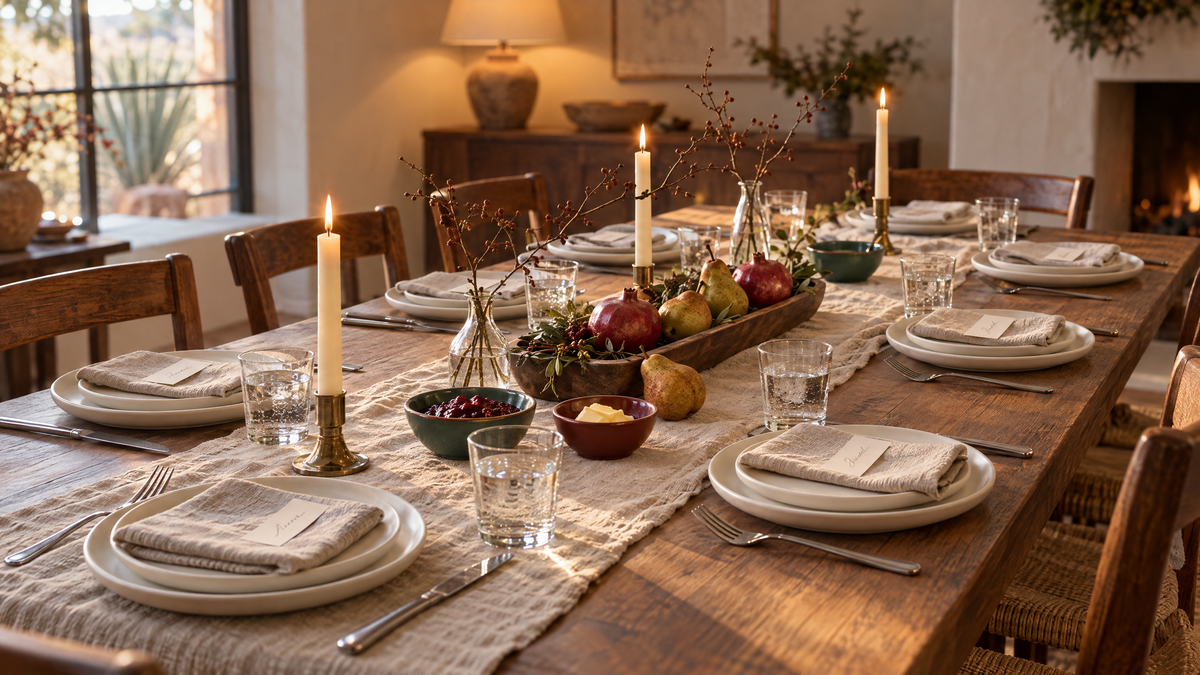
For a centerpiece with some movement, begin with a low, narrow tray placed slightly off-center. Arrange a few pears and two or three pomegranates loosely across it, leaving some of the tray visible. Let one piece of fruit sit just beyond its edge, so the arrangement feels connected to the table rather than confined to a container.
Add two or three small bud vases with a few slender, non-toxic branches. Choose stems with interesting bends, and turn them so their lines travel along the table. Keep the view between guests clear; sit down to check it as you work.
The combination is simple: rounded fruit, fine branches, the small shine of glass. The fruit’s colors can pick up a detail elsewhere, perhaps an earth-brown rim or the Cranberry and Evergreen tones of the Winter Collection.

Place a few unscented tapers in stable holders outside the arrangement, with generous clearance from branches, cloth and passing sleeves. Flameless tapers work well where space is tight.
The tray makes the centerpiece useful. When dinner arrives, lift it onto a sideboard and leave the small vases behind. The table keeps its character while making room for the meal.
Limited edition
The Winter Collection
Cranberry, Evergreen and White Pepper, each finished with a hand-painted earth-brown rim. Made in Tucson and available only through the end of the year.
 Cranberry
 Evergreen
 White Pepper
Give each place one small pleasure
A cloth napkin feels generous without requiring an elaborate fold. Fold it into a long rectangle and lay it across the plate, with a handwritten name card on top. That’s enough.

For a more personal detail, write a short, specific note on the back: “So glad we get you for the whole weekend,” or “Save room for the apple pie.” Keep it light and individual, something to discover rather than read aloud.
If your table is long, repeat the little necessities. Put butter and salt within reach at both ends. Divide the cranberry sauce between smaller bowls. These modest changes keep the meal moving and spare guests the stretch across someone else’s plate.
Leave coffee cups and dessert plates off the table until they’re needed. A little empty space looks good, and it gives everyone somewhere to rest their hands.
Look at the room from a guest’s chair
Once the table is set, sit in a few different seats. Notice what you can see and what you have to reach around. Move the vase that interrupts a sightline. Turn the platter handle away from someone’s elbow. Make sure the end seat has as much room as the others.
Then look beyond the table. Switch on a nearby lamp so the room has a warm edge instead of relying entirely on overhead light. Give coats and bags a place away from the chairs. Clear a small surface for drinks, and leave a pitcher of water where someone can help themselves.
Finally, choose your own seat with care. If you’ll be moving between the kitchen and dining room, an easy route means fewer apologies and less shuffling. Set out what you can ahead of time, including the things you’ll want when dinner is over.
The table will look different by then. A few crumbs on the cloth. Half a pear left in the centerpiece. Candles burned lower, chairs drawn closer. Leave it that way for a while. There’s still coffee to pour.

A Thanksgiving table timeline
Everything above, in the order it happens.
One week before
- Count the chairs and place settings, including the end seats.
- Match a serving piece to every dish on the menu, then add the gravy, butter and dessert.
- If something is missing, fill the gap now rather than on Wednesday.
Two days before
- Set the table with empty dishes and handwritten labels.
- Add serving utensils and trivets, then take a photo of the layout.
- Press or steam the tablecloth and napkins.
The day before
- Build the centerpiece on its tray, low enough to see across.
- Write the name cards, and a note on the back of each.
- Stage the mugs and dessert plates on a sideboard.
Thanksgiving Day
- Clear a landing spot at the kitchen end of the table.
- Put butter, salt and cranberry sauce within reach at both ends.
- Switch on a nearby lamp and fill a water pitcher.
- Warm the dinner plates: set them in a cold oven, turn it to its lowest setting, and let them warm together.
After dinner
- Lift the centerpiece tray onto the sideboard and pour the coffee.
- Cover the leftovers in their serving bowls and put them straight into the refrigerator.
Thanksgiving table questions
How many serving pieces do I need for Thanksgiving?
Count every dish on the menu and give each one its own piece. A turkey and five sides needs six platters and bowls, and then a gravy boat, a butter dish and dessert plates. Setting the table with empty dishes a day or two early is the surest way to know.
Can HF Coors dinnerware go in the oven?
Yes. HF Coors dinnerware is ovenproof and broiler safe, so you can warm plates and serve a side in the dish it was heated in. Avoid sudden temperature changes: let frozen pieces return fully to room temperature before they go into the oven, and set hot dishes on a trivet rather than a cold surface.
Is it safe for the dishwasher, microwave and freezer?
Yes. Every piece HF Coors makes is lead-free and dishwasher, microwave and freezer safe, so leftovers can be stored and reheated in the same bowls they were served in.
Where is HF Coors dinnerware made?
In Tucson, Arizona. HF Coors was founded in Inglewood, California, in 1925 and moved production to Tucson in 2003. The factory, offices and factory store share one building on South Cherrybell Stravenue.
Made here. Made to last.
Every HF Coors piece in this post is made at our factory in Tucson, Arizona, from clay and glazes we mix ourselves and fire in our own kilns. It is the same vitrified ceramic we make for restaurants, so it is built for a long holiday: oven to table, table to dishwasher, leftovers to the freezer. See how it is made.
Shop the table
 Studio Coupe Large Oval Handled Platter
 Winter Collection Dinnerware Sets
 Studio Coupe Extra Large Serving Bowl
 Studio Coupe Large Oval Serving Bowl
 Studio Coupe Butter Dish
 Studio Coupe Mugs, Set of 4
Browse: Studio Coupe Matte White · American White · Winter Collection · Serving Platters · Serving Bowls
Keep reading


